
Blog

How to Study the Scriptures

Blog

Image generated via Midjourney

Write a numbered list of instructions on how to study the Bible to learn more about Jesus Christ.

1. Pray and ask God to reveal Himself to you through His Word.

2. Read the Bible with an open heart, asking the Holy Spirit to guide and teach you.

3. Study specific passages that talk about Jesus Christ and His character.

4. Meditate on what you have read and learned, and apply it to your life.

5. Share what you have learned about Jesus Christ with others, and be a light for Him in the world.

Benjamin James, via OpenAI API

Write a numbered list of instructions on how to study the Book of Mormon to gain a testimony of its truthfulness.

1. Pray to Heavenly Father and ask if the Book of Mormon is true.

2. Read the Book of Mormon and look for evidence that it is true.
a. Look for spiritual experiences or feelings you have while reading.
b. Look for answers to specific questions you have about the gospel.
c. Look for ways that the Book of Mormon can help you in your life.

3. ponder and study the Book of Mormon.

4. Ask Heavenly Father if the Book of Mormon is true.

Benjamin James, via OpenAI API

From this we can tell that the training data for GPT-3 includes probably includes text from www.churchofjesuschrist.org.

That last response has some redundancy in it, let’s see if we can get a better result.

Write a list of instructions on how to know if the Book of Mormon is true, and then write what conclusions can be drawn if it is true.

1. Read the Book of Mormon and pray about it.

2. Consider the evidence.

3. Compare what you read in the Book of Mormon to the Bible.

4. Look for answers to your questions.

5. Test the Book of Mormon by living its teachings.

If the Book of Mormon is true, then Joseph Smith was a prophet of God, the Church of Jesus Christ of Latter-day Saints is true, and Jesus Christ is the Savior of the world.

Benjamin James, via OpenAI API

I think point #5 is a worthy inclusion in the list, and goes right along with a verse from the New Testament, where Jesus teaches how to know if what he is teaching is true:

If any man will do his will, he shall know of the doctrine, whether it be of God, or whether I speak of myself.

John 7:17

P.S. I tried lots of different text prompts to get an image of the brass plates, but this is a close as I could get in a reasonable amount of time.

Benjamin

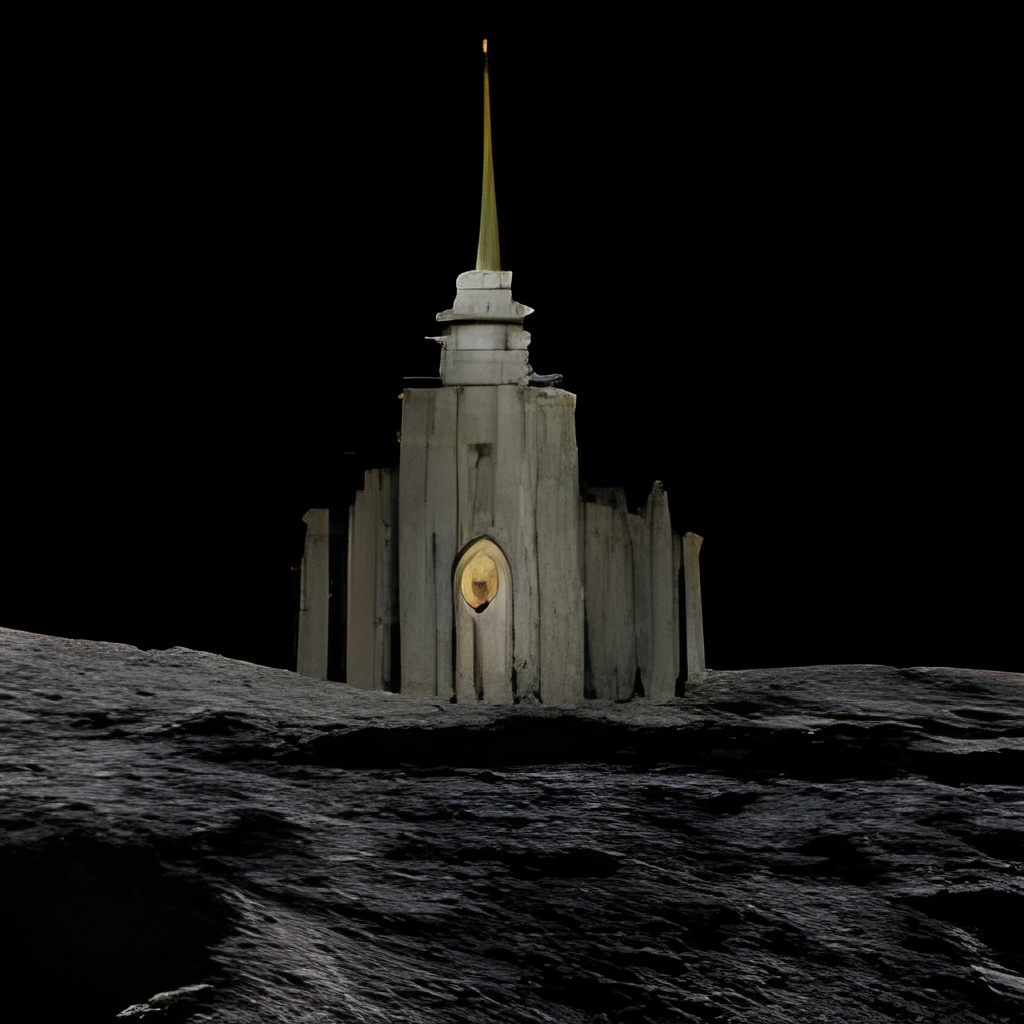
The Temple on the Moon

Blog

“A photo of a latter-day saint temple on the surface of the moon”, www.craiyon.com

Today’s tinkering topic is Text To Image generation (TTI). A few months ago we heard about DALL-E 2, a artificial intelligence tool “that can create realistic images and art from a description in natural language.”

While this is not the first TTI generator, it is the most impressive that I’ve seen so far. It inspired an open source project, originally called DALL-E Mini, since renamed to Craiyon, which is open to public at www.craiyon.com. Since most people don’t have access to DALL-E 2, that’s what I’ve had to settle for, but it’s still quite impressive itself. I would describe it as looking at DALL-E images through a fuzzy window pane.

You can see in the image on the right, I asked it to create “a photo of a latter-day saint temple on the surface of the moon.” This was one of the better ones (the entire result of 9 images is shown below), but when I increase the size of the image, you can see that the details don’t quite line up properly. A sad limitation of the current model they are using, but still quite impressive what they can do with limited resources.

One thing that is true about all of the text to image models I’ve seen is that the more specific the prompt, the closer to that prompt the image output will be. If I say “a temple on the moon,” it’s much less precise.

Here’s a “painting of an old main with a gray beard sitting at a desk writing on brass plates of metal.”
(I’m trying to get a picture of someone like Lehi).

It doesn’t quite understand “brass plates of metal,” and the faces are quite creepy, but it gets the overall point across.

If you want realistic faces, the site https://this-person-does-not-exist.com/en is a much better tool.

Anyway, the next time you want to illustrate something, maybe AI can help you out.


Benjamin

The 4 Xs of Prayer

Blog

www.craiyon.com

Today’s entry comes from my brother, who wrote:

There are four “X”s of prayer

1. eXpress: We express our thoughts and feelings to Heavenly Father. We tell Him what is on our mind and in our heart.

2. eXamine: We examine our lives and seek His guidance. We ask for His help in overcoming our challenges and becoming our best selves.

3. eXperience: We experience His love for us. As we pray, we feel His love surrounding us and filling us with peace and happiness.

4. eXtend: We extend our love to others through prayer. As we pray for others, we feel closer to them and more connected to the human family.

Matthew James, via OpenAI API

Because there is some randomness in the way the responses are generated, the model is able to come up with multiple responses to the same prompt.

Here are some different ones:

1. eXpress your love for Heavenly Father. Let Him know how much you love Him and are grateful for His blessings in your life.

2. eXplain your concerns and needs. Be specific in your requests. Tell Heavenly Father what worries you and what you need His help with.

3. eXpect an answer. Believe that Heavenly Father will hear your prayers and will answer them in His own time and in His own way.

4. eXperience the power of prayer in your life. As you pray regularly, you will see the power of prayer at work in your life in wonderful ways!

Matthew James, via OpenAI API

 I believe consistent prayer is very important to having a healthy spiritual life.


Benjamin

Journaling

Blog

Write a daily journal entry of a young man who has recently been studying the New Testament, including things he learned about the teachings of Jesus.

Dear journal,

Today was a big day for me. I’ve been reading the New Testament, and I’ve finally reached the teachings of Jesus. I’m not sure what I expected, but His teachings were really interesting. He talked a lot about love and forgiveness, and He seemed to really emphasize helping others. I also found it interesting that He said we should treat others the way we want to be treated. That’s something I definitely want to remember.

I’m still digesting all of His teachings, but I can already tell that they’re going to have a big impact on my life. I’m excited to see how His teachings play out in my own life, and how I can use them to help others.

Benjamin James, via OpenAI API


Write a blog post of a young man who has recently been studying the New Testament, including things he learned about the teachings of Jesus in the Sermon on the Mount.

I’ve been reading through the New Testament lately and I’m really struck by the teachings of Jesus in the Sermon on the Mount. In particular, I’m amazed at how radical and counter-cultural they are.

For example, Jesus says that we should love our enemies and pray for those who persecute us. He also says that we should not worry about material things, but instead seek first the kingdom of God.

These teachings fly in the face of everything our society tells us. We’re taught to look out for ourselves first and to hate our enemies. But Jesus is saying that we should do the exact opposite.

It’s hard to wrap my head around it all, but I know that Jesus is calling us to a higher standard. A standard that is counter-cultural and often difficult, but ultimately rewarding. I’m excited to continue learning about what it means to follow Jesus and to live out his radical teachings in my own life.

Benjamin James, via OpenAI API

I think it’s neat how the specificity of the prompt so strongly affects what the AI writes.

If you’d like a quote from a real person about journaling, here’s a good one from a former president of the church:

The Lord has told us that what we seal on earth shall be sealed in heaven and what we record on earth shall be recorded in heaven, and what is not sealed or recorded on earth is not sealed or recorded in heaven. Therefore it appears to be very important that we do keep a true and faithful record in all things.

Wilford Woodruff, Teachings

Benjamin

Jon BythewAI

Blog

There’s a neat tool created by OpenAI called GPT-3.  It’s one of the largest natural language processing neural networks ever created.  The company offers access to the API for free for small requests, and I have been having a lot of fun tinkering with it.

Here’s an example; I asked it to “Write a short description of GPT-3 that includes its capabilities,” and it said,

GPT-3 is a natural language processing platform that enables developers to train and deploy AI models. It offers a wide range of capabilities including text classification, entity recognition, and sentiment analysis.

Benjamin James, vi OpenAI API

I used to have a blog that I posted on regularly, but life has caught up to me and I can no longer write as often as I would like to.  Maybe GPT-3 can pick up the slack for me and write some short, fun, and uplifting anecdotes.

Yesterday Jon Bytheway addressed young adults on the topic of preparing spiritually, saying:

“Be prepared, but don’t panic!”

He said that while we don’t know when the end of the world will be, we have a charge to be prepared and not to panic.

He compared it to having an exam and preparing for it, but not panicking. We don’t know when the exam will be, but we can prepare. When we face challenges in life, we can remember that Jesus went through challenges too, and He knows what we are going through.

He encouraged young adults to:

1) Be prayerful

2) Be positive

3) Be pure

4) Be prepared

He also encouraged young adults to be ready to serve and to be missionaries. Elder Bytheway shared some of his own experiences of being called on a mission and of serving a mission. He said that serving a mission is a great way to be prepared for whatever challenges life may throw at you.

He then asked the young adults to stand and commit to preparing spiritually for whatever may come in their lives.

Benjamin James, vi OpenAI API

I would like to start a series where I use the OpenAI Playground to create short, uplifting spiritual messages.  I’ll only include the results that make sense.

The prompt (things that I write) will be in italics.

I hope you enjoy this fun little adventure with artificial intelligence.


Benjamin